Showing posts with label Reviews. Show all posts

Thursday, March 23, 2023

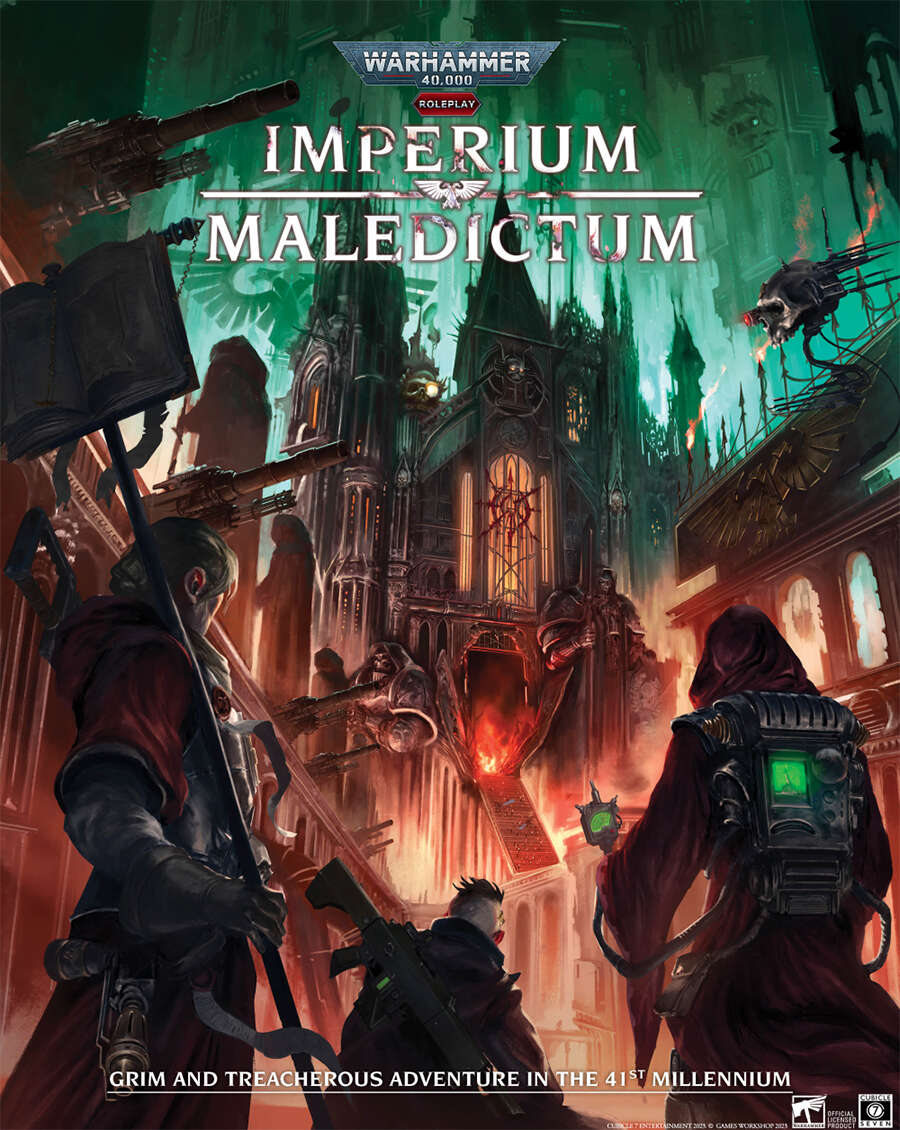
Spotlight on Imperium Maledictum a Warhammer 40,00 RPG


I've always been a sucker for the lore and setting of Warhammer 40,000 and while I've owned several of the RPGs set there I've never actually played any of them. Imperium Maledictum from Cubicle 7 just released today and I hope to rectify that sometime later this year.

This new RPG treads similar ground to Dark Heresy with the the Characters working for a Patron and hunting down heretics and xenos who seek to corrupt and destroy the Imperium of Man.

Imperium Maledictum uses a d100 system very similar to their Warhammer Fantasy Role Play 4th Edition where Success Levels see the result of the 10s die subtracted from the Tens Place of a Skill but seems to lack the Momentum mechanic introduces in the latter game.

Before Character Creation begins you are walked through creating a Patron for the group to work for. I've really enjoyed the Eisnhorn and Ravenor novels and both of them were larger than life characters whose agents were and extension of what made them so cool and I like this approach. The Patron has ties to and influence with several Factions serving the Imperium that range from Adeptus Mechanicus to Astra Millitarum to Inquisitors to Rogue Traders. The Patron's ties and mission are the indicators for what type of game the GM plans to run and I like this choice.

Character Creation begins with what the game's Characteristics that include Weapon Skill, Ballistic Skill, Strength, Toughness, Agility, Intelligence, Perception, Willpower, and Fellowship and start out at 20+2d10. If you choose to roll randomly place them you gain a 50 XP bonus for Advances later.

Origin comes next which tells you what type of world you come from and gives you 2 Advances for specific characterstics and equipment. Again, randomly choosing you grants you bonus XP for later.

Your Faction determines who you were trained by within the Imperium. Options included are the same as during the Patron creation process and gives you the possibility of being a telepath, serving the Navy, or even an outlaw. In the fiction, servants of the Imperium will use nearly any resource or being in their crusade against the forces of Chaos and the Faction portion of creation captures that exceptionally well.

Roles are next and include Interlocutor (negotiators or interrogators), Mystic (psykers), Savant (experts), Penumbra (assassin's or thieves), Warrior, or Zealot. Each presents Talents, Skill Advances (each grants +5%), Specializations to Skills (a Skill can only be improved by 4 Advances or +20% and Specializations allow you overcome that limit), and Equipment.

Looking at Advancement it seems that the Career system of WFRP 4E is not used and it appears you can simply spend XP to increase Characteristics (to a max of 60%), Skills, Specializations (no more than 4 Advances, as well), and Talents.

The PDF released today for $29.99 and I'm still making my way through the book but I'm liking what I'm seeing. Cubicle 7 makes great products and this is no exception with the layout and art successfully showcasing the 40k's atmosphere and look.

I'm really pleased with my purchase and have already made a character. I went the fully random route ending up with a Zealot who works for the Adeptus Ministorum and born on a Feudal World who uses a Chainsword and with Specializations has 69% chance to attack a creature. I was able to create him in under 20 minutes which I found fairly impressive.

You can find IM here.


Sunday, March 19, 2023

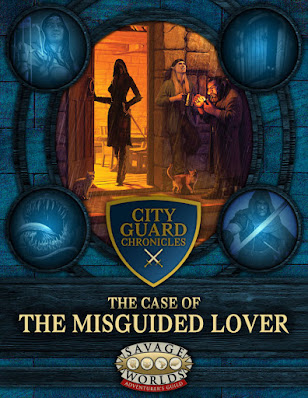
Spotlight on City Guard Chronicles: The Case of the Misguided Lover for Savage Worlds


I have always had a soft spot for fantasy city settings like Lankhmar, Sanctuary, Ankh-Morpork, and the City-State of the Invisible Overlord and in the early days of this blog I created Jarlsburg, my ode to each of them.

Recently, the City Guard Chronicles: The Case of the Misguided Lover was released by Jan Jetmar and Cyril Ronseaux for Savage Worlds Adventure Edition and I purchased it immediately. It was an easy decision as both have done excellent fantasy supplements for SWADE such as Tomes and Prayers, Wand Magic,  and Wizards and Mystics.

The product comes in at 37 pages and gives you an overview of The City and ideas on which cities it would be in settings like Golarion, Eberron, and Hellfrost.

What follows is a tale of murder, betrayal, demonic pacts, and vengeance that is clearly laid out on a timeline starting 9 days before the adventure begins (what a great tool). The organization and lay-out are great for an over-busy Game Master and the scenes it shares leave plenty of room for any improvisation that might be necessary.

I don't want to give the plot away but I think it nails an investigative approach that paints those involved with enough complexity that their varies crimes are relatable and and layered.

I've been looking for a Savage Worlds setting I can run on nights our primary GM is unavailable and this is a great way to kick off a return to Jarlsburg for me and I can't wait for more City Guard Chronicles.

You can purchase it here.

Thursday, February 23, 2023

Spotlight on Gargoyle 74 by Stellagama Publishing


Gargoyle 74 is a retroclone of the 1974 White Box of Dungeons and Dragons by Tammiro Levi and Omer Golan-Joel and published by Stellagama Publishing. I'm a big fan of Stellagama and Omer and have purchased many of their products such as Sword of Cepheus and the Quantum Engine games such as Barbaric! and I received this PDF for free as a review copy.

Ability Scores grant a -1 with a 6 or less, +0 with a 7-14, and +1 with a 15-18. I'm a fan of this spread. It allows customization but it's not overly fiddly. Only Fighters add their Strength mod to their attack rolls.

Wisdom has been replaced by Intuition and I like that decision. I think Wisdom might have a different meaning than it did in the '70s so I'm cool with it.

You have the big 4 classes in the Cleric, Fighter, Mage, and Rogue. Fighters get a 2nd attack at 5t level and Rogues have a Subterfuge skill that is an X chance on a d6 roll. All classes use the same XP table and there is one Saving Throw stat but classes gain specific +2 bonuses for certain types.

Ascending AC is used.

There are roles for 1 GM and 1 Player included, as well.

We get full rules for magic items and monsters all in just this single book of 114 pages.

There are 3 Appendices and the first features the Non-Human Race-as-Classes.

Antediluvans are inspired by Elric's Melniboeans and are your Fighter-Mage class. I love this choice and it's a testament to both authors that a clone of this version of DnD can still surprise me.

Dwarves are next but their skin is copper, their beards bronze, and "If one listens closely, it is possible to hear a faint ticking sound coming from each dwarf. This is the sound of the gears turning and grinding inside each dwarf." Another neat surprise that is just cherry on top. Their metal bodies given them a bonus to AC, they have an innate bonus to Hit Points, healing spells don't work on them, and there is a very specific way to bring them back from the dead.

The third and final Non-Human are Lizard-Kin who can hold their breath for long periods of time, their AC improves as they level, and they have natural attacks with their claws.

Appendix B features Treasure and Appendix C features numerous random tables including building a dungeon.

I'm really happy with this product and I think it jumps to the head of the class as my favorite White Box clone. The rules have a nice Sword and Sorcery feel that I've also enjoyed with Barbaric!.

I'll probably start running this with my 9 year old to induct her into our OSR fellowship in the next few months.

I cannot recommend this product enough. In fact, I cannot recommend any Stellagama product enough. All of my purchases have been extremely satisfactory and you should check out what they have to offer.


Saturday, January 7, 2023

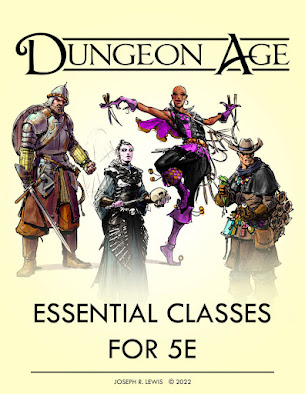
Spotlight on Essential Classes for 5E


 I've been a fan of Joseph R. Lewis' Dungeon Age products for DnD 5E and OSE for a while now. His adventures are really easy to use as a Dungeon Master as he lays out his products in a very clean way while maintaining loads of flavor and atomosphere and his products have become a must-buy for me. 

With Essential Classes for 5E he has created four full classes, the Mercenary, Necromancer, Occultist, and Spyder, all with unique mechanics and tons of flavor that are best suited for dark fantasy. These classes give characters new unique Actions, Bonus Actions, and Reactions as their class abilities and each has special mechanic that involves failure when rolling a 1 on a d6 and damage to yourself.

The Mercenary Class is a combination of a fighter and a thief in the tradition of Conan and at 2nd Level you gain the Crude Medic ability: As an Action, heal yourself or one creature within 5 feet using old bandages smeared with a salve. Gain HP equal to 1d6 + your Mercenary level. Some of their abilities use a mechanic powered by Fortune that requires you to roll a d6 and on a 1 the ability fails and you take damage equal to 3 x your Mercenary Level. 

By level 20 a Mercenary gains 7 new Actions, 6 new Bonus Actions, and 5 new Reactions and all of the other classes, the Necromancer, Occultist (think Hellboy, Simon Belmont, or John Constantine), and the Spyder (assassin/thief), gain similar mechanical abilities.

Here are a few examples:

For the Necromancer at Level 6: Animate Greater Thralls which is powered by their Mortis mechanic: As an Action, choose any dead creature that is Medium or smaller within 60 feet and animate it as a Undead version of its original form. Use the Ghost stat block for this thrall. It obeys you and acts on your turn. It endures until you dismiss it or it is destroyed. A destroyed thrall cannot be animated again. At any one time, you can have a maximum number of ghastly thralls equal to half your Int modifier rounded up. Since it uses Mortis that means you roll 1d6 and on a 1 you take damage.

Here is an example of an Occultist ability at Level 2 called Bell of Law and it is powered by the Doom mechanic: As a Bonus Action, ring this small copper bell. All creatures within 60 feet that can hear suffer Psychic damage equal to 1d6 + your Occultist level. Lawful creatures are immune to this damage. Doom works the same way as Fortune and Mortis.

For the Spyder at Level 5 they gain the Metal Hair ability: You infuse your own hair with the iron in your blood. This natural helmet makes you immune to Charm effects and Psychic damage. This effect works no matter how short you cut (or shave) your hair. Their equivalent to Fortune and the others is Spyder. 

These classes pair old school pulp archetypes with 5E's modern mechanics as full classes but they lack of sub-classes and I don’t mind that choice as much as I thought I would. I’ve never complained about sub-classes but its a mechanic I’ve grown bored of and would happily run a game using just these Essential Classes. I’m going to add that Joseph is very clear that these classes aren't balanced against the traditional classes and that was not one of his design goals.

I hope we see more of these and I'm trying to find time to see them in play with one of his many great adventures.

I heartily recommend this or any other Dungeon Age product.


Saturday, December 3, 2022

Spotlight On Dragonbane or Drakar och Demoner Beta


First, I've always been a fan of ADnD's D20 roll equal to or under an Ability score and have brainstormed about expanding it into a full blown game for decades. Second, I love how easy it is to teach someone Basic Role Play/Call of Cthulhu/RuneQuest' percentile system. Third, I think DnD can be a bit daunting for new players with some of its concepts.

Dragonsbane (here in the States) or Drakar och Demoner's newest edition addresses all three of those things for me. I think it is an excellent RPG to teach to new players and yet rich enough to hold the interest of veterans. It has the roll under mechanic that older editions of DnD and ADnD utilize and while it doesn't use a percentage system I like how it sets base Skill chances and Trained Skill ratings.

DB or DoD for short, has six Attiributes: Strength, Constitution, Agility, Intelligence, Will, and Charisma. They are rated on a scale of 3 to 18 and are rolled using the classic 4d6 drop the lowest die. Your Ability score sets your base chance to perform a Skill, which range from 3 to 7 and if you are Trained in a Skill you double that amount. 

The game features six Kin: Humans, Halflings, Elves, Dwarves, Mallards (apparently DoD borrowed from Chaosium's RuneQuest and therefore uses that game's Ducks) and Wolfkin or wolf-like humanoids, Dog Men, if you will. Each kin has a Heroic Ability which requires Willpower, a pool of points equal to your Will Attribute, to be used. They are a lot like Feats from DnD and can have a broad spectrum of effects.

After choosing your Kin you choose a Profession, which is not a Class, but a group of Skills, Heroic Ability, Gear, and some form of Personalization such as an object from your past or a series of scars. You must choose to be trained in four of your Profession Skills during character creation and there are currently 16 which range from Swords and Marksmanship to Spot Hidden and Survival. The number of starting Skills is dependent on your age with younger characters being Trained in 5 Skills but a +1 to Agility and Constitution, adult characters being Trained in 6 Skills and old characters being Trained in 7 Skills but taking a -1 to Strength, Agility, and Constitution and a +1 to Will. The developers are planning to add more Skills, going to 25 of them, in the next Beta update and instead of each Profession have a specific Heroic Ability you will be able to choose the one you want.

Character creation yesterday took me about 15 minutes which is ideal, in my opinion and I really enjoy that this is a Skill based game so that while I might not start out with one of the three Magic Schools (Animism, Elementalism, and Mentalism) I can choose to study them at a latter point in the game. Experience is similar to BRP's you put a check next to any Skill you used that session that rolled a 1, called a Dragon and a Critical Success, or a 20, called a Demon and a Critical Failure. Additionally, you also answer the following six questions and put a check by a Skill of your choice at the end of each session. 
   Did you participate in the game session? 

   Did you explore a new location?

   Did you defeat one or more dangerous adversaries?

   Did you overcome an obstacle without using force? 

   Did you roleplay according to your motivation?

For each Skill checked you roll a D20 and need to exceed the Skill Rank with a success adding +1 Rank to it.

If you want to learn certain Skills you will have to seek training for a period of time. Additionally, you gain a new Heroic Ability every 5 sessions.

Armor subtracts from damage unless its from a spell and weapons range from 1d6 to 2d10 with a damage bonus (a D4 or a D6) from exceptional Strength and Agility Attribute scores.

To cast spells you make your Magic School's Skill check and spend the appropriate amount of Willpower Points even if you fail your Skill roll. You can decide to inflict damage upon yourself to gain WPs ranging from D4 to a D20 but you also take damage of the same amount.

I really, really like this game. I'm hoping to run some newer gamers through it and I am really glad I backed it. I even upped my pledge after reading the Beta.

I think it has a lot of charm and really flows into the background during play. 

Late Pledges are currently available on the KS page.

Thursday, November 17, 2022

Spotlight: Shadowdark RPG Quickstart


I've written a bit about the Shadowdark RPG from The Arcane Library so I thought I'd highlight what I think sets it apart from other OSR products I own.

The game's author has mentioned she wanted to build the game from B/X DnD's foundation and obviously, with the success of Labyrinth Lord and Old School Essentials, B/X DnD seems to be the most popular, at least within the OSR. Shadowdark does use a unified roll high mechanic, as well as, a Difficulty Class system that we've seen since DnD 3, but I also think Call of Cthulhu, Basic Role Play, and other percentile systems are inspirations too. DC's in Shadowdark are 9, 12, 15, and 18 and since Ability modifiers are the focus (skill just grants Advantage) in it, those map to a 60%. 45%, 30%, and 15% chances of success before Ability modifiers come into play.

When a Wizard or a Cleric casts a spell they roll against a DC of 10 + the Tier (level) of the spell and if successful the spell is cast and some spells have bonus effects on a Natural 20, but if you fail the spell doesn't go off and is lost for the day. I think adding spellcasting to the unified approach to the rest of the system makes far more sense, especially to new players, than the various exception-based and sub-system approach to B/X, its clones, and DnD's "vancian" spell casting as a whole. This also eliminates Saving Throws as a separate sub-system because when a spell requires some kind of roll on the Target's part it is merely another Ability Check.

One of my favorite parts of the game is that when rolling damage you don't add your Strength or Dexterity modifiers to damage. If you gain a bonus it comes from a class Talent or a magic item. I think this slightly speeds up combat as even people that are excellent at addition can take an extra bit of time totaling the die and adding something to it. 

The final bit that appeals to me are the Class Talent tables mentioned above, at 1st and every odd numbered levels you roll 2d6 on table with specific Talents for your class. These tables give you bonuses to attacks, ability scores, Advantage with particular spells, and additional uses of class abilities. I know that Shadowdark didn't come up with this idea but I'm really glad they included it and I like that the advancement rate it uses has that Old School feel. I remember when Wizards of the Coast began talking about "dead levels" when your Hit Die was the only thing you got and while I do appreciate mechanic abilities I also like rulings over rules and the mindset behind a game where what I do as a player and a character can be as much as what I and the DM think should happen and not "rule for everything" approach. As a new gamer having a rule for everything did help me out and we have millions of new DnD players that want and need that kind of structure but the OSR's allure, for me, was the DYI approach. With those Talents only coming every other level I think it keeps a lot of what makes a character unique specific to the player and their adventures. This is the kind of game where let's say there is aa character that bargains well through role playing, I'm comfortable not requiring a dice roll to succeed or at the very least give them Advantage on their roll. The fact that the bonuses are fairly bounded and most bonuses will never go above +4 combined with the chance of success the DCs  represent gives me a very tight engine where the math is very clear and I love that.

I know that the Shadowdark RPG is yet another game in a crowded area featuring a number of B/X D&D clones and derivative works but I really feel that the game's author Kelsey Dionne had a similar goal to Joseph Goodman when he published Dungeon Crawl Classics. Their aim was rooted in older editions of DnD as a guidepost and the end goal of both games honors that era while blazing new ground.

Do I own a bunch of OSR clones? Yes. But. I'm going to run the Shadowdark RPG while many of them gather dust.

Right now you can purchase the Shadowdark RPG Quickstart in print or digitally, there will be a Kickstarter for it in March of 2023.

Wednesday, November 16, 2022

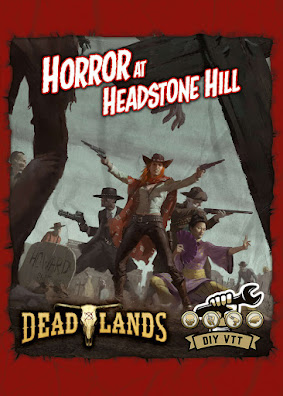
Spotlight: Horror at Headstone Hill for Deadlands & Savage Worlds Adventure Edition


Horror at Headstone Hill is a sandbox campaign for the Deadlands Weird Western RPG for Savage Worlds Adventure Edition.

It presents to you the entirety of Uinta County, Wyoming beginning Mid-May of 1884. The County's important areas are broken down for the Game Master and important people are introduced and statted out. A timeline of the settlement is also presented to help the setting take shape. While there is a central adventure presented here, like many Savage Worlds products, several dozen Savage Tales are included as well. These Savage Tales help the GM fill in information about certain areas, groups, personas, and critters and give them handy smaller adventures.

The level of detail for the setting is pretty perfect for my habits as a GM, which means the basic information is well presented but there is enough left open to easily customize the campaign area. To help bring my tastes into focus I can get very bored of dry descriptions of room after room or dense background information and this product has none of that. I think I spent less than an hour reading over the County and main campaign or Plot Point in SW terms. I then spent another 30 minutes skimming Savage Tales and where they might intersect certain NPCs or locales. I took some notes of less than a page for use in the game and at the table. My prep was less than two hours but when our first session began I felt very prepared. As a 50 year old gamer with not enough free time I love that Pinnacle gets this is important for a busy GM.

Horror at Headstone Hill works so well for me because it gives a light, but solid foundation to use as a springboard so that when my Players inevitably (within an hour of the first session) went for something I wasn't expecting I had enough information sketched out for me that I could roll with it pretty easily. And while about half of the first arc of the Plot Point has been central to the Character's actions I have not missed a beat by using this product's many options to ad lib player driven plot lines .

This product is literally perfect for my GMing style. I'm not overwhelmed with information while having plenty of resources to make Headstone Hill a living region. The box set and its maps are wonderful and I use my MacBook at the table to quickly look up something in the PDF if I haven't noted it.

I could not ask for a better tool to help wade into Deadlands for a long term Campaign, my first attempt, a few years, back didn't go as well and HaHH lets me confidently adjudicate unforeseen situations.

I'd also like to state that while I've owned every edition of Savage Worlds, it's newest edition known as SWADE, communicates information far better than any of the previous core rules and all of the SWADE products I've purchased have been top-notch. In a lot of ways, I think it took technology and our industry to catch up to what Shane Lacy Hensley originally envisioned for SW (I remember his original format was going to be three-hole punched products that you could print off as the rules changed or when errata was corrected. I'd also like to take a minute to call out how much I enjoy having the SW Power Cards and Status Cards at our table. I tend to forget who is Shaken or Wounded or has what Condition and the cards make that so much easier to remember while communicating the appropriate rules, as well.

HaHHH succeeds as a great product for any GM wanting to run Deadlands. While I think it could be used with other systems I don't think it would succeed as well if the setting did not have magic, weird tech, Native Americans, and undead desperados. I also love that this product is a box set which scratches the nostalgia itch I have for 1990s TSR AD&D and Role Aids products I loved so much.

I heartily recommend Horror at Headstone Hill and I'm excited that a similar product will be Kickstarted for Savage Rifts by PEG on Black Friday.  I will wholeheartedly back that project too.

Thursday, March 17, 2022

5E: Valda's Spire of Secrets' Necromancer Class


After running Hyperborea 3E for several sessions my group and I decided to use the setting but switch over to DnD 5th Edition. One of my players was a Necromancer and we were both underwhelmed by the Necromancy tradition in the Player's Handbook. After looking through the PDFs of things we had Crowdsourced I remembered that Valda's Spire of Secrets had sever new Classes and dozens of new Sub-Classes.

The Necromancer caught my attention with the new Cantrips available to it like Eye of Anubis that deals necrotic damage and prevents the target from taking the Disengage action until the end of your next turn or Minor Life Steal that damages your target and gives you that many Temporary Hit Points. 

The Class itself has d6 Hit Dice with Saving Throws in Constitution and Intelligence and at Level 1 it gets Spellcasting and Charnel Touch which is the reverse of a Paladin's Lay On Hands but doesn't affect Constructs and Heals Undead.

At 2nd Level they gain Thralls that lets your animate small and medium dead creatures with a CR cap that grows as you level. As written the undead you use Raise Dead on count agains this cap but a an optional rule is presented if you want to throw caution to the wind. 

Also at 2nd Level they gain the Bag of Bones feature that lets them store Undead.

At 3rd Level they choose a Grave Ambition that includes Blood Ascendant where they become a vampire, Death Knight where they focus on becoming a dark warrior, Overlord where they excel in manipulation and are backed up by their undead minions, Pale Master where they focus on the "traditional" type of Necromancer, Pharoh which is a more balanced focus on Arcane and Divine magics, Plague Lord where their magic focuses on plagues, Reanimator that mixes science and magic, and the Reaper where you adopt the aspects of Death itself. Additionally, they can expend a Spell Slot to replenish your Charnel Tough pool.

At 5th Level if a creature rolls a natural 1 on a Saving Throw against one of their Spells they automatically fail their Save and take double damage. Additionally, your Critical Success range on Spell Attack Rolls is 19 and 20.

At 7th Level their Thralls are immune to being Turned

At 18th Level they can use their Reaction to Heal a Thrall.

And at 20th Level they perform the Rite of Lichdom.

I'm really curious how this class will perform at the table and should see it in action this coming weekend.

One of my favorite aspects of Valda's Spire of Secrets is the tone of the book and the innovations I see in the Classes and my intention is to use large swaths of it at my table.

Thursday, June 18, 2020

Spotlight on Soldiers of Fortune for Shadow of the Demon Lord


If you've read much of this blog you know that my favorite RPG is Shadow of the Demon Lord and it was created by the extremely talented Robert Schwalb.

Rob has released dozens upon dozens of support products for SotDL and Soldiers of Fortune is the newest and features 3 Expert classes for martial characters and can be purchased for $1.49.

In SotDL you can start at 0 or 1st level. If you start at 0 level you pick an Ancestry (think DnD Races) while at 1st level your character also picks from Warrior, Magician, Rogue, or Priest. At 3rd level you pick an Expert Path which allows you to choose from options such as Assassin, Druid, Oracle, or Witch. There is no restriction on what direction you can go and you can be as diverse or as focused as you want in leveling your character.

Soldiers of Fortune presents 3 Expert Paths with a Martial bend.

First is the Bloodletter which focuses on melee combat. Its features at Level 3 include Bloodlust that gives you the option of gaining a variable bonus that you can choose to either hit a target or substitute it for your weapon's damage and Sacrifice the Weak which gives you a bonus against targets that are already injured.
   At level 6 Taste Victory allows you another opportunity to generate Bloodlust each round and Surge of Hate give you an opportunity to use your Bloodlust to temporarily heal.
   Finally, at level 9 Spill the Blood increases the amount of damage Bloodlust does to an Injured target and Rising Bloodlust that lets you generate Bloodlust faster.

Second is the Commander which at level 3 grants a bonus to 2 Attributes, adds an additional Profession or Language, and Battle Plan that allows you to create specific Effects when certain Triggers occur. What is cool is that these Effects can be offensive to enhance your allies and defensive to hinder your enemies.
   At level 6 Go With the Flow allows you to grant a Bane to attack rolls against you or your allies within range.
   And at level 9 Master Commander allows you to grant a Boon to allies within range and a Bane to enemies within range.

The final Expert Path is Targeter which focuses on bows and crossbows and at 3rd level, they gain a bonus to 2 attributes, an additional Profession or Language, Arrow Stab that allows you to use arrows and bolts as melee weapons, Pepper With Arrows that grants a bonus to damage, Steady Hands that lowers the number of Banes on an attack roll.
   At level 6 Targeter grants you to Keen Vision which extends the range of your Perception and Bottomless Quiver.
   Finally, at level 9 Collateral Damage grants you the possibility of hitting a separate target on a missed attack roll, Precise Shot that boosts your weapon's damage and Test the Wind which allows you to alter the actual number rolled on an attack's D20.

As a fan of SotDL this is a must buy and I cannot recommend it enough.

Tuesday, February 11, 2020

Review: Jungle Tomb of the Mummy Bride for D&D 5th Edition


Jungle Tomb of the Mummy Bride is an adventure for Dungeons and Dragons 5th Edition written by Levi Combs and published by Planet X Games. 

The Adventure is 66 pages and is designed for Characters of 5th through 7th level, the Player's Pack is 12 pages, and the Treasure Maps is 9 pages.  All three feature black and white interior illustrations with color covers.

A PDF of this adventure was provided to me in exchange for a review.

Okay, we have that out of the way now, let me start by saying what I love most about this adventure is its attitude, it is out to make sure that a group who plays it has fun. I really like that attitude.

The adventure is set within a dangerous jungle that houses the undead Mummy Bride. Levi makes it clear that this module focuses on Cannibalsploitation, Cenotes (a natural pit or sinkhole), and a Grindhouse-style. It explains these three tenets very clearly to help the Dungeon Master grasp its style. We are also quickly giving Rumors and Wandering Monster Tables. They are on self-contained pages and are clearly laid out. Additionally, Planet X introduces the Trope Mechanic and very clearly gives you advice on ways to emulate the Grindhouse-style with very clear ways to capture it's essence and ad-lib when the Players, inevitably, stray from the path.

I thoroughly enjoyed this adventure and even stole a large portion of it to run a one-shot using the TinyD6 game system when I needed an adventure to cover for an absent DM.

It's strange because when I began planning for my 1st DnD setting, I was inspired by Tarzan for some reason and this Adventure reminded me of that.

I don't want to spoil too much but if you like Cannibals, Mummies, Demon-Toads, Cannibal Gods, Undead Piranha and Crystal Skulls then you will love this adventure.

The Dungeon features three levels and ways to expand the setting, including a local village and other temples to explore. Additionally, there is an Appendix featuring magic items and monsters.

I can't recommend Jungle Tomb of the Mummy Bride enough. Buy it here as quick as you can.


Also, Planet X Games currently has Kickstarter for an OSR Zine, The Phylactery, and you should check it out too.


Tuesday, December 31, 2019

Review: Torchlit Adventures


Gallant Knight Games has, in the last few years, published a good number of excellent games. One of these is Torchlit Adventures which is inspired by early editions of Dungeons and Dragons while still managing to tread new ground. 

I was provided with a PDF copy of the game for review purposes and this post uses affiliate links to allow me to buy more games and artwork.

The product is 72 pages with color covers and black and white interior images. The art is very professional and appealing and the illustrations are of a very high quality.

In the Foreword, Alan Bahr, the game's author explains why he created another OSR game. Basically, he took DnD, dashed it against a rock and stood on the shoulders of giants to create Torchlit Adventures.

The Introduction explains that TA will be the foundation upon which future OSR products will be released from Gallant Knight Games. I wonder if that will include the Kickstarter for Michael Spahn's second edition of The Hero's Journey which I believe starts around January 7th (Mr. Spahn confirmed it will not, though he loves TA).

Chapter 1 goes over TA's basics, and the primary rule is that Narrator has the right to modify the rules as they seem fit. It reinforces that "This is your game. Play it your way.", which is a core principal of the OSR. 
   Skill tests in TA, generally, require rolling X or higher on a D6. The Narrator sets what X is and certain class abilities or situational modifiers can lower the die to a D4 or increase it to a D8, D10, or D12. Most Skill tests default to 4 or better while a Skill test's appropriate Ability modifier is applied to the roll, as well. There is no set Skill list, the Narrator and player will determine if your background or class provide any benefits for a Skill test.
   Advantage and Disadvantage, from DnD 5E, are used for D20 rolls.
   Saving throws are a single type modified by level with certain exceptions called out as as Class abilities, they essentially work like Swords and Wizardry.
   A section calls out that a goal of TA is to be able to fit a Character on a 3" x 5"card.
   Torchlit Adventures' Abilities are different from most OSR games, they are: Might, Learning, Insight, Fortitude, Agility, and Charisma. Generating Ability scores is, to me at least, unique. Essentially, you roll 5D6 and assign each individual roll is assigned a number between 1 and 5. A player  then chooses what Ability gets a 12, what two Abilities get an 11, and the remaining Abilities are assinged all 10s. A player then adds the first D6 to the Ability that is a 12. Next you choose one of the Abilities you set at 11 and subtract the first D6 and add the second D6 to it and continue to subtract the previous D6 roll while adding the current D6 roll, it works like this:
Attribute 1 (12) + D#1 
Attribute 2 (11) – D#1 + D#2 
Attribute 3 (11) – D#2 + D#3 
Attribute 4 (10) – D#3 + D#4 
Attribute 5 (10) – D#4 + D#5 
Attribute 6 (10) – D#5
   Ability modifiers range from -1 to +4, with +0 in the 7-14 range. Charisma has additional uses with your score determining how many Hirelings you can have and what their Loyalty is.   
   Additionally, if your Class' Primary Ability score 15+ you gain a 5% bonus to Experience. Having an Insight and/or Charisma scores are 15+ you gain a 5% bonus to Experience for each. Essentially, you can have up to a 15% bonus to Experience with the appropriate Ability scores.
   Lifeblood are your hit points and is determined by taking a character's Ability score and adding their level.
   Player's are encouraged to determine what their Profession is and mechanically upgrades the dice being rolled. For instance if the Narrator chooses the default difficulty of 4 or better and a character must make an Insight roll, first they will apply an Insight Ability modifier and if a Profession or Class ability applies it will upgrade the D6 to a D8, meaning the character would need a 4 or better on a roll of the D8.
   Character retirement is also covered, currently the existing classes only go to 10th level and while the Narrator is encouraged to created rules for 11th level and beyond, having a character retire is an appropriate situation in TA.

Chapter 2 covers TA's Classes which are Fighter, Thief, and Sage. 
   Damage in TA is class dependent, a rule that I'm pretty darn fond of.
   Fighters are what you expect in an OSR game, but they gain extra attacks per round, up to 4. Additionally, at character creation, a Fighter needs to choose between Marksman, Sword and Board, or Landsnecht which grant a bonus and a penalty as, essentially, fighting styles. Additional class features include increased Loyalty for hirelings, weapon specialization, a bonus to Saves against Death and Poison, and establishing a stronghold.
   Thieves again are very straightforward, Thievery works just like any other Skill, the Narrator sets a difficulty of at least 2+ and a D6 is rolled while adding the appropriate Ability modifier. At later the die is upgraded for Thievery. 
   They may establish guilds, use disguises, know how to use poison and a bonus to Saves vs Traps and Poisons
   Sages are a bit of a hybrid of Magic-User and Cleric. They can't wear armor and are restricted by what weapons they may use. They don't start casting spells until 4th level and they max out at 3rd level spells. When casting a spell, a Sage makes a Learning Skill test with a difficulty of 4 + Spell level, if they fail the roll and suffer 1d6 per Spell level in damage, at later levels their Skill die increases. A Sage must choose between Healing Hands or Martial Historian (this lets them be proficient in any weapon and therefore gain access to any Properties it might have) at 3rd level. Additional class features include Scholar, Sense the Unseen, and a bonus to Saves vs Wands and Staves, Traveller's Trinkets (you can produce a small non-magical item with a Skill test).

Chapter 3 is Equipment with lists of gear, one thing that I find unique is that weapon charts don't assign damage, because your Class determines the damage you do. What weapons do have are Properties to set them apart from each other. Some of the Properties include Armor Piercing (Armor in TA reduces damage and doesn't make you any harder to hit), Brutal, and Defensive.
   In place of Armor Class, a character has Defense which has a base of 10 and is modified by a character's Agility and Insight.
   Weapons degrade in TA with a simple check by rolling a weapon's damage die with degradation occurring on a 1 or 2. Armor, likewise, degrades after a battle it was used in, until repaired it will reduce 1 less damage in the next fight and this is a cumulative affect. Fixing weapons and armor can be done in towns or during Camp Actions, which I will get to later.
   There is a chart for what types of Hirelings cost for an adventure.
   Magic Items in TA aren't just +1 swords, in fact, they aren't crafted. They grow as an adventurer does through their wielders exploits and triumphs. When wielding a weapon, if you roll a 20 and then invest 100 Experience (you can't lose a level to do this) then you get to assign a Property to the weapon and you can continue to do this while wielding it through your campaign with every 1000 Experience you place into the Magic Weapon. There is even a Magic Item History table to roll upon to shape your weapon's backstory. Magic Armor has a similar cost, but it requires you to survive a critical hit.

Chapter 4 are the rules of the game and covers the particulars of Skill tests, Attack rolls, and Saving Throws. 
   Group Initiative is rolled on a D6. Movement is in feet per turn depending on encumbrance. A character or NPC dies at 0 Life Blood. When a natural 20 is rolled your damage dice are maxed out and doubled and you can do an Exploit, something cool that you and the Narrator can agree upon. Meanwhile, a natural 1 is a fumble and you drop your weapon which has 1-2 chance of breaking on a D6 roll. 
   Special Actions include, Reckless Attacks, Cautious Attacks, Feints, and Disarms. Healing and binding wounds (something I hadn't thought of since ADnD 2E), Invisible Opponents, Morale, Loyalty, Negotiation, and the Environment and it's hazards are all covered. 
   One mechanic I want to spotlight is Grim Effort, which allows you to spend Life Blood to gain a 1 for 1 bonus on any D20 roll.

Chapter 5 Spells and Magic are the sole purview of Sages. They are required to find new spells for their Spellbook so that, starting at 4th level, they may then prepare a number of spells based on level that they want for the day. To cast a spell requires a Skill test with failure meaning damage of 1d6 x the spell's level. 
   There are twelve 1st level spells presented, five 2nd level spells presented and five 3rd level spells presented. You can easily convert spells over from other OSR games if you want expand the options for a Sage. The spells presented aren't the offensive juggernauts in most OSR games, there are no magic missiles or fireball. In fact, cause light wounds is the only damage dealing spell I see, but sleep is presented.  
   At first, I was a bit put off by the lack of damage dealing spells, but the spells chosen reinforce that Sages are more than a fireball and allows a Sage to focus on wondrous effects more modern DnD players don't always choose. Sadly, in my experience with DnD 5E, damage per round is king and I'm glad this paints a better picture, to me the Sage is more Gandalf than Elminster, both are powerful but their tools are different.

Chapter 6 Camping is one of the more intriguing rules presented in TA. When resting characters must consider the usual Camp Defenses, as well as, partake in up to two Camp Tasks such as Aid, Cook, Guard, Hunt, Repair, Rest, Scout, Tell as Story or Sing a Song, and Train. These actions help heal Life Blood, fix equipment,  protect the Camp from danger, and gain a bonus to a particular Skill test during the next day. 
   Essentially, the Narrator makes a Save vs the number of characters in the group, but the various Tasks the characters take modify that number. The Narrator is even provided with a Potential Danger chart to roll upon.
   I'm sure all groups deal with camping and dangers, but I really dig how TA presents it and provides the Narrator with clear tools to use against the characters, while simultaneously, laying out how the players might protect themselves against the Narrator's toolkit.

Chapter 7 Journeys gives the Narrator clearly laid out information to understand a hex and how quickly or slowly characters can traverse it. A hex is 8 miles and at a normal pace, a person can travel three hexes per day without undo fatigue. Each hex has a dominant terrain, but is not limited to only that terrain. Rules for Provisions and Terrain are provided for use to cover possible starvation and how each hex will adjust speed by its predominant terrain.
   Character Roles are provided to manage the journey and they are Guide, Lookout, Quartermaster, and Guard. During the journey each Role can attempt to gain benefits from the hex they are passing through.
   I've long wanted to run a hex crawl and in 4 pages, I've got the tools do so.

Chapter 8 involves Lighting and what will cause a light source to dwindle and how different types of Lighting or darkness affect the players and their enemies. Something to keep in mind, only humans  are presented and the assumption is that there is no "darkvision" or "infravision" for players.

Chapter 9 covers Legacy, which gives rules for giving a Hireling Experience to replace a fallen player character. Essentially, Hireling benefit from a very streamlined Experience total that can buy levels to replace one of their employers. 

Chapter 10 features Mass Battles and introduces Army Might, which defaults to 10, and is then modified by various modifiers such as, No Option To Retreat, Fighting on Home Turf, and a Unique Relic. 
   Once Army Might has been calculated for each side, we are introduced to Player Actions which can modify the heart of a Mass Battle, the Command Check. 
   Players Actions can generate a bonus from 1 to 3 which, if successful, provides a cumulative bonus to the Command Check. The higher Command Check wins that round and the difference between them is subtracted from the loser's Army Might. When Army Might reaches 0 a D6 roll of 3+ allows that Army to retreat.
   If a Command Check is a 6, then an Army can recover Army Might due to rallying their troops. 
   It's a very straightforward and quick way to add a bit of epic scope to the player's careers.

Chapter 11 covers Threats to your players which each having Lifeblood, Defense, Environment, Attacks, Qualities, and XP value.
   Qualities are special rules that feature things like flying, cowardice, and regeneration. 12 Threats are featured and include dragons, orcs, and skeletons and it will only take a few minutes to convert a favorite enemy from any other OSR game with the provided rules.
   Hirelings are also provided to quickly and easily flesh them out.

In my opinion, Torchlit Adventures provides a familiar, yet innovative approach to the OSR, it treads familiar territory while walking a different path. At it's core, it's a derivation of Swords and Wizardry, but the author has gone to considerable lengths to produce something unique. I love the Camping, Journey, and Mass Battle rules and any OSR game could benefit from them. Additionally, I am excited to see how Alan Bahr and Gallant Knight Games supports it.

Finally, TA includes a 20 page setting called Carinhollow to help you learn and apply the Journey and Camping rules.

Torchlit Adventures is for you if you enjoy OSR games and want a more grounded approach to magic. I feel that it would work best in the Hyborian Age or Lankhmar and isn't as suited, out of the box, for the Forgotten Realms, which was fully the author's intention.

I heartily recommend Torchlit Adventures and look forward to running it soon.

Friday, November 22, 2019

Review: 5th Evolution: Carbide City #1

I'm always on the lookout for a good superhero game, especially one that runs on the Dungeons and Dragons 5th Edition chasis. While Mutants and Masterminds is a very good game, it doesn't scratch my itch because I don't care for it's damage system. I like hit points, but I also have been looking for a superhero game where buckets of dice weren't necessary. I'm glad to say 5th Evolution: Carbide City #1 from Limitless Adventures fits the bill.

I was given physical and digital copies of 5th Evolution: Carbide City #1 for review purposes.

I'm going to talk about the formatting of Carbide City #1, nine of it's 45 pages is a comic book to introduce you to the setting and it's super powered inhabitants. I really like this, the art is excellent, the layout is great and it's fun. For some reason it reminds me 80's and 90's role playing games, Teenage Mutant Ninja Turtles from Palladium Books, in particular.

The book opens with a brief overview of the world and Carbide City itself. This leads into four encounters and ends with running a campaign in the setting. 

Next is equipment and then we are given write-ups for minions and henchmen. After that we are given full statistics and back stories for ten supervillains. Additionally, there is a "further adventures" section for each villain.

Then we are given ten superhero Archetypes: Blaster (Cyclops), Brick (Colossus), Feral (Beast), Gadgeteer (Forge), Ghost (Kitty Pryde), Martial Artist (Shang Chi), Marksman (Scalphunter), Speedster (Quicksilver), Telepath (Emma Frost), Teleporter (Nightcrawler).

Unlike other superhero RPGs, 5th Evolution: Carbide City strictly uses Archetypes for character creation, there are no rules for building a character with points or randomly rolling one. You pick an Archetype and work with your Game Master if you want to change things up. The Archetypes are 12th level characters and honestly, if you are well-versed in DnD 5E, you could build your own.

I really like this approach. I have numerous games where I can customize and min-max my character to the fullest, but this is a great way to just get the ball rolling. I honestly find it refreshing.

We are told that 12th level characters are lower powered than many of the superheroes in comics and I can see that, but I find the power level to be good for say the X-men of the 60s, 70s, and 80s.

Additionally, each Archetypes Advancements to improve them instead of using Experience Points.

5th Evolution: Carbide City #1 (plans for a #2 were mentioned with additional Archetypes) was like a breath of fresh air, it's easy to get going and yet complete and most importantly, fun enough to keep new and veteran players interested for a full campaign. I cannot recommend it enough.

Finally, Limitless Adventures is running a Kickstarter for 5th Evolution: Whitechapel which is in it's final hours right now.

You should check it out.

Tuesday, November 5, 2019

Review: Frayed Ends for Shadow of the Demon Lord


Robert Schwalb released Frayed Ends for Shadow of the Demon Lord on Monday. Rob and Schwalb Entertainment have been juggernauts with releases, often weekly, and the support has made Shadow of the Demon Lord a phenomenal game.

Rul, the setting of Shadow of the Demon Lords, is a dark realm that is about to face its end. One side effect of the horrors that adventurers face is Sanity loss. Frayed Ends provides six random tables filled with random Quirks to relieve a character's mind of the madness they have endured. In the core rules, a player would work with GM to determine what Quirks would develop from gaining madness. These tables replace that interaction.

First you roll a d6 to determine what table to use. Then you roll a d20 to gain a Quirk.

Let's say that my d6 roll is a 3 and my d20 roll is a 7, my result is "You believe you can fly and might try to prove it when given a chance."

Or this time my d6 is a 2 and my d20 roll is a "Whenever you see a shiny object, you must get a success on a Will challenge roll or, when you are next able, be forced to move toward that object."

I like the Quirks as an option for the GM and player to fall back on in case ideas are not forthcoming.


Thursday, October 31, 2019

Review: Icons Presents


Icons Presents is described as "kind of a sequel to Icons A to Z" and presents "an alphabet soup" of options for Icons Superhero Roleplaying: Assembled Edition. The PDF is 142 pages long, the art is by the awesome Dan Houser and written by Steve Kenson. A PDF of Icons Assembled was given to for review purposes.

I've always been fascinated by Icons and Steve Kenson has, in my opinion, a spiritual successor to TSR's Marvel Super Hero RPG (AKA FASERIP), with Dan Houser's art being truly on point.

Armed Forces and their weaponry are covered in this chapter. We are given stats for vehicles used by Land Forces, Sea Forces, Air Forces, and Special Forces (in this case battlesuits and drones).

Next come Countdown to Doomsday!, which walks you through choosing a your game's Apocalypse. Are you just destroying civilization, life on earth, the earth, or everything? And what motivates your villain? Are they bluffing about what they are willing to do? Are they seeking power by sacrificing countless lives? Are they looking to protect a planet from those who endanger it? Are they simply trying to make sure that no matter what they survive? These questions really help you plan your campaign. There are three chapters to your Doomsday Scenario: the looming threat comes first and allows your heroes to become aware of the threat they are facing. The gathering storm is second and can be the longest of the three chapters, it allows the heroes to beginning fighting the main villain and gain insight into what they are trying to destroy. Finally, the final confrontation is the climax where the heroes make their stand, but will they succeed or fail? Failure is explored in this section and expands on how the heroes can move forward and what they might be able to do to pick of the pieces.

Deities and Demigods explores playing or interacting with the gods and their children. It helps you decide who and what the gods are in your game and then explores appropriate Divine Abilities, including Attributes and the various powers, specialties, and qualities they might have. A template is provided as a basis for a god. The differences between demi-gods, divine heroes, divinely empowered and the divinely created are highlighted. And the interaction between god and mortals is explored.

Enemy mine explores the roles of villains. Are they the twisted reflection of a hero, are they equal but opposite to them, the all-important nemesis, or merely an adversary with no restrictions to their theme? Team villains also get spotlighted.

Fists of fury details martial arts and explores if they are Ability or Quality driven, how to use martial art Qualities, explores Maneuvers, explores tactics where the character makes a sacrifice in order to gain a benefit, and presents some martial art Powers.

Icons of infamy presents how to run the bad guys in your campaign. Have all the heroes been defeated and it requires the villains to step up and fight the good fight? And if they win will they continue to work together? Or would you like to run a game inspired by Suicide Squad? Are the new heroes in town really villains in disguise like Marvel Comics' Thunderbolts? Have you ever wanted to be a part of a villain school like the Hellions in the X-Men universe? Are you the type of villain that would help going after worse villains? Is your hero posing as a villain to get on the inside of a sinister team or organization? Or have your heroes been wrongly dubbed outlaws and have to operate illegally to prove their innocence? All of these scenarios are covered in this chapter.

Minions and Masterminds outlines different ways to treat henchman, rivals, masterminds, and menaces within the Icons rules.

Panels vs pages give advice on how to tell your stories, including help with advanced techniques such  as flashbacks, foreshadowing, interludes, retcons. There are also some great tips on handling events, arcs, and even imaginary stories in your campaign.

Situational qualifiers covers Advantages, Trouble, Limited Qualifiers, Place-Based Qualifiers, Time-Based Qualifiers, Status-Based Qualifiers and how to handle Qualities in play.

The space patrol explores handling sci-fi settings such as DC's Tommy Tomorrow or cosmic police al a the Green Lantern Corps.

Sword and sorcery handles using Icons for a fantasy game or moving your heroes to a fantasy setting. New character creation options are presented and common fantasy monsters are presented.

Taking initiative gives new options including variant Abilities for initiative, rolling for initiative each round, who goes first, declared actions, round robin initiative, card-based initiative, bidding for initiative, tiered initiative, and one-shot conflicts.

Tell me the odds presents the dice probabilities of Icons and presents several dice rolling variants.

The world is mine presents schemes for villains to use and include conquest, extortion, mind control, and altering reality. Then we are presented how to rule the world once your scheme succeeds.

The unobtanium factor explores materials like adamantium, Nth metal, and tritanium that permeate comics. Their properties and origins are explored and several examples are presented.

Vigilantes and Villains concludes the book and coverer street-level heroes, their foes, and the gray areas they face. Additionally, new character creation rules, rules options, and tools of the trade are explored.

There is a lot to love about Icons Presents and I think it can help breathe new life into an existing game or help a fledgling Game Master craft their tale. I heartily recommend it and find it a great expansion for Icons.

Tuesday, October 22, 2019

Review: Scheherazade The One Thousand and One Nights


I was given a PDF copy of Scheherazade The One Thousand and One Nights RPG by Umberto Pignatelli and Spaceorange42 for review purposes.


I want to point how stellar the book's layout and art is in this 171 page PDF. Both are beautiful and very evocative of the setting presented in Schereazade.

In the Introduction we learn that Player Characters in this game are folks that Schereazade met and that they told their tale to her. I find this a really cool set-up and it ties into the game's central goal: determine what happened to Schereazade and possibly wake her up to save the Caliphate of the Eternal Moon.

Schereazade is powered by the Unique System: The ranks of two Attributes and a Concept (if applicable) are added together and that many d6s are rolled, a 4 or better is a success and if you equal or exceed the Difficulty (from 1 to 10) then your action is successful. Additionally, one of the dice in the pool has to be a different color, it's value cannot be changed by Unique Gifts and if it rolls a 1, something negative occurs even on a successful roll. Further, if it rolls a 6, something positive occurs even on a negative roll.

The character creation chapter introduces us to Schereazade's three Attribute couples: Power and Precision, Courage and Caution, Passion and Reason. Resources is it's own Attribute.
   Characters have 12 Marks to spend on Concept, Attributes, and to acquire Magic by spending 2 Marks to buy the Gifted Status. You can roll on a table to randomly choose a Concept.
   Secondary Attributes are Life (hit points) and Energy (which powers magic).
   Next a Unique Gift is either created or rolled on a table and has two numbers associated with it. The first is the scope of Your Gift and the second is the Rank of your Gift. In the end a Unique Gift should like this: When the [Scope applies] I can do [the Rank of the Gift]. Here is an example, "I am really strong, I can expend Energy to have extra dice in feats of strength" or "I can become an animal once per session". It kind of reminds me of 13th Age's One Unique Thing, but it has a mechanical effect.
   Each character starts with 1 Moon point, they are very rare and very special and may be used reroll dice or create a story element. A PC can only have up to 4 of them a time and they can be earned by saving someone's life while risking your own, being really heroic, finding an outstanding solution to a problem, or telling a story between rests even between sessions. 
   Your character begins play with clothes and three pieces of equipment. Finally, you can create connections with another PC and reveal how they knew Schereazade.

Treasure obviously may be found during an adventure and are treated as Treasure Points, a special type of experience point. The can be spent to place Marks in resources or "burned" to "buy" a very costly item.

Gear in Scheherazade is handled Keyword Points that can have a positive or negative effect in game. Keywords range from Frail (an negative) to Entangling to Defense. It's an interesting concept and allows you to create items better suited to your character.

Casting spells requires the spellcaster to a set amount of Energy, may have special Components, and has both a Duration and a Range. I found the spells available to be useful and flavorful for the setting.

The running the game chapter has good advice for game masters of any level of experience and advises a "Session Zero" to start a game off and focuses on Campaign planning, hooks and focus, and special situations.

Opponent keywords and stat boxes are presented next and are appropriate to the setting. We have antagonists like Cannibals, Fire Jackal, and Skeletal Warrior.

The Story of the Goat, the Glutton, and the Shepherd is a beginning adventure and good introduction to setting. I will gladly use it for my first adventure playing Scheherazade.

This is a great game, it has compelling mechanics and feels authentic for the setting it presents. I heartily recommend it to anyone who is a fan of Aladdin, One-Thousand and One Nights, or Al Quadim.


Tuesday, October 15, 2019

Review: Savage Company Recruit Orientation Guide


The Savage Company Recruit Orientation Guide is a Free PDF that introduces you to the Savage Company Setting from SHM Publishing that is now on Kickstarter.

The SCROG PDF is designed for the Pathfinder 1st Edition rules, however the Savage Company Setting is designed for Pathfinder 1E and Dungeons and Dragons 5E.

The SCROG is 65 pages, full color with good art and an excellent layout that allows you to play in a military Sci-Fi setting with the PF1 rules.

The guide opens by introducing us to the Savage Company itself, that began it's existence as a mercenary company for orcs and half-orcs. As the business flourished the Company set up base on Tombstone and anyone who wanted honest work killing people was welcome.

We are introduced to Tombstone, the hub of the Company and its environs.

Next we are introduced to 8 new races for Pathfinder 1st Edition: Baade, Kemano, Lobstross, Savage Bugbear, Savage Hobgoblin, Savage Kobold, Savage Orc, and Skeletal.  Baade are intimidating red-skinned creatures, Kemano have concealable animal traits, and Lobstross are large aquatic creatures. The races are built in the format of the Advanced Race Guide for PF1.

Following that is a chapter detailing 19 Archetypes ranging from Infantryman to Hexslinger to Zen Gunman.

Three new Feats are presented next.

The PDF is rounded out by nine pages of weapons, vehicles, and equipment. The list presented easily covers things you'd need to test out the Savage Company setting.

I think the SCROG does a great job of interesting you to the setting and the tone of the types of adventures you would experience in a Military Sc-Fi setting. I enjoyed reading the PDF and encourage everyone to download to check it out, I mean it's free.

I'd recommend this to fans of PF1 and DnD5 who want to shake up either game with a Sci-Fi bend.

Monday, October 14, 2019

Review: Gunzo! Operation Bug Hunt for Dungeon Crawl Classics


I'm a big fan of Eric Bloat and Bloat Games line of products. He was kind enough to give me an advance PDF copy of Gunzo! Operation: Bug Hunt for Dungeon Crawl Classics for review purposes, it was written by Eric with additional writing by James Spahn.

OBH is a military space setting for DCC that is designed to emulate movies like Aliens, Predator, and  Starship Troopers and comes in at 56 pages.

The art for OBH is well done and channels the setting perfectly.

The PDF opens with some fiction and moves into the five new Classes for the setting.  We are introduced the Combat Medic (healers with the ability to install cybernetics), Engineer (they repair and disable machinery and try to figure out what alien tech does), Grunt (the soldiers with boots on the ground and weapon specialists), Pilot (their piloting skills also cover ranged combat), and Robot (they have packages that they can take that cover combat, diplomacy, mechanical operations, and medical care, additionally they have a self-repair feature).

Next we go over starting cash, and appropriately your rank indicates your pay, except for Robots who don't get paid.

New armor, gear and weapons are presented to and allow the PCs to travel the universe, killing their enemies before they can launch an asteroid at Buenos Aires.  We are given heavy army whose laser reclective plates protect the wearer from all forms of attack to ion whips to grenade launchers. Your players will have plenty to spend their pay on.

The cybernetics chapter opens by letting the GM decide if their is a limit to how many cybernetics a character can have and then covers all the parts necessary to upgrade you to major badass.

The horrors of war are also covered with a section for Pressure and Shell Shock. If you gain too much Pressure you have to roll on the Shell Shock table where you can just start killing any living beings around you to simply losing your next action. I'm glad Eric included this, because it reminds you that your character isn't just a killing machine and all of these operations have long term effects on your psyche.

We are given a random Bug Generator to help the overtaxed GM keep things unique and interesting.  Several of the tables use D16s and d14s so make sure you have your DCC dice handy.

OBH ends with a bestiary of your favorite cinematic horrors and the art is very well done.

Eric gives you everything you need to run the Mobile Infantry or Space Marines (the ones from Aliens) in a tight package.  You could easily hang out watching any of the films that inspired OBH and then make some characters and be playing within a half an hour.  You can't ask for more than that.

The Dungeon Crawl Classics Rulebook is necessary to play Operation: Bug Hunt.

This is another home run for me  I urge you to pick it up when it releases.


Shadowdark & Gamma World

  I ran the Lost Citadel of the Scarlet Minotaur and the Players made it through about 1/2 of the dungeon.  It went well.  I did lower HP fo...